
Excipients directly influence drug release profiles, long-term physical and chemical stability, and the ultimate manufacturability of the drug product. API–excipient incompatibilities — if undetected early — can lead to degradation, loss of potency, and formulation failure during stability studies or clinical trials. Our excipient selection and compatibility studies identify these risks systematically, enabling rational formulation design from the start.
Excipient selection is tailored specifically to each API based on its physicochemical properties, BCS classification, intended route of administration, target patient population, and dosage form requirements. Compatibility studies are designed to detect both chemical (degradation, adduct formation) and physical (polymorphic conversion, moisture uptake, recrystallization) incompatibilities under stressed conditions.
Broad-spectrum binary API–excipient compatibility studies investigating critical chemical and physical interactions — using stressed conditions (thermal, humidity, photostress) and multi-method analytical characterization to identify incompatibilities before prototype development begins.
Selection of the most appropriate excipients for your target dosage form and manufacturing process, tailored to your API based on four critical pillars: physicochemical properties, route of administration, intended indication, and target species.
Container-closure and primary packaging material compatibility studies — including extractables and leachables (E&L) risk assessment to identify potential chemical interactions between the drug product and its packaging components.
The choice of excipients affects virtually every critical quality attribute of a drug product. Excipients influence:
Identifying incompatibilities and optimizing excipient selection early — before significant formulation investment has been made — directly reduces the risk of late-stage formulation changes, stability failures, and regulatory deficiencies.
Our excipient selection process is specifically tailored to your API to directly improve bioavailability and exposure levels. We base every decision on four critical pillars:
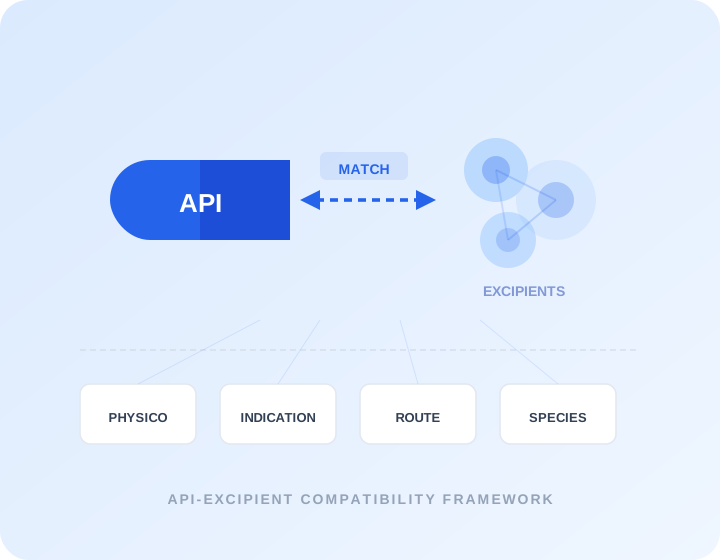
Solubility class (BCS), pKa, LogD, solid-state form, hygroscopicity, particle size, and chemical stability profile — these properties define which excipient categories are suitable and which pose incompatibility risk for your specific API.
Excipient selection for oral solid dosage forms (tablets, capsules) differs fundamentally from parenteral, topical, or inhalation formulations. Only excipients with established safety data for the intended route of administration are considered.
The therapeutic indication, target patient population (adult, pediatric, geriatric), and clinical context influence excipient acceptability — including daily intake limits (ADI), pediatric safety restrictions (ICH E11A), and patient acceptability requirements.
For preclinical in vivo studies, excipient selection must account for species-specific GI physiology, tolerated excipient dose levels, and the potential pharmacological activity of excipients in non-human species — factors that do not apply in clinical formulations.
Have a question or need support with your project? Please complete the form, and our team will get back to you shortly.
Our capabilities span three specialized platforms:
Small Molecule
Crystal Bio Solutions
Crystal NAX
By providing your e-mail address, you agree to receive an e-mail response from Crystal Pharmatech to your inquiry. The information you submit will be governed by our Privacy Policy.
Subscribe to be the first to get the updates!