
Technical Article
Applications of Dynamic Moisture Adsorption in Crystal Research
22 Nov 2023

Published Mar 26, 2026
This practical CMC guide shows how humidity and temperature together affect solid forms, influence stability and manufacturability, and support better study design, control strategies, and packaging decisions.

Humidity and temperature do not affect solid forms independently. In pharmaceutical development, they act together to determine whether a material remains in its intended form or converts to a hydrate, anhydrate, different polymorph, deliquesced phase, or, in amorphous systems, a recrystallized state. Because solid form can directly influence dissolution, stability, and processability, this interaction is a practical CMC concern.
Relative humidity determines how much water vapor a material is exposed to, while temperature affects both the thermodynamic equilibrium between solid forms and the kinetics of transformation.
In hydrate-forming systems, the humidity threshold for conversion is not constant and can shift significantly with temperature. For example, in theophylline, the monohydrate form appears above approximately 43.2% relative humidity at 20 °C, but only above 74% relative humidity at 50 °C, showing that the humidity boundary between solid forms can shift substantially with temperature. [1]
This coupling between humidity and temperature is equally important for amorphous materials. Water uptake can increase molecular mobility and lower the glass transition temperature (Tg). When moisture and temperature together bring the material closer to or above its Tg, the system becomes more susceptible to structural relaxation, sticking, agglomeration, or recrystallization.
In practical terms, conditions that appear safe when humidity or temperature is considered alone may become problematic when both variables interact.
When humidity and temperature act together, they can drive several important solid-state changes, including hydrate–anhydrate interconversion, deliquescence, phase conversion, and amorphous recrystallization. For crystalline APIs, even modest changes in RH can shift the stable form. In one MGAT2 inhibitor example, different phases were observed at 25% RH, 35% RH, and 60% RH at 25 °C, showing that the same material can change form depending on environmental exposure. In co-crystals, high humidity may lead to deliquescence followed by precipitation of a less desirable form, while in amorphous systems, water uptake can increase molecular mobility and trigger phase separation or recrystallization. [2]
This matters in CMC because a single stability condition such as 25 °C/60% RH does not define the full solid-form risk. What teams need to understand is the broader hygrothermal operating space:
where the target form is stable
where transitions begin and whether they are reversible
how quickly they occur
Without that knowledge, form changes may appear later as drifting XRPD patterns, unexpected moisture behavior, altered dissolution, or inconsistent downstream processing. In practice, temperature and humidity should be treated as development variables that directly support solid-form control, not just as final storage conditions.
Amorphous solid dispersions are especially sensitive to moisture. Water sorption can increase molecular mobility and alter the thermodynamic balance of the system, increasing the risk of phase separation or recrystallization. These changes can significantly affect dissolution behavior and product stability.
A practical approach to evaluating humidity and temperature effects starts with moisture sorption studies at multiple temperatures, rather than relying on a single relative-humidity screen.
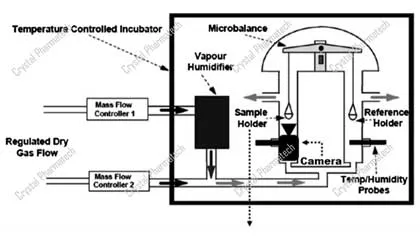
Dynamic vapor sorption (DVS) is particularly valuable because it measures mass changes under controlled temperature and humidity conditions. This technique allows researchers to detect:
Sorption steps
Hysteresis behavior
Hydrate formation or dehydration
Vapor-induced phase changes
Importantly, DVS experiments require only small quantities of material, making them useful during early development.
DVS results should be supported by additional analytical methods. Hydrate and polymorph questions often require orthogonal confirmation through techniques such as:
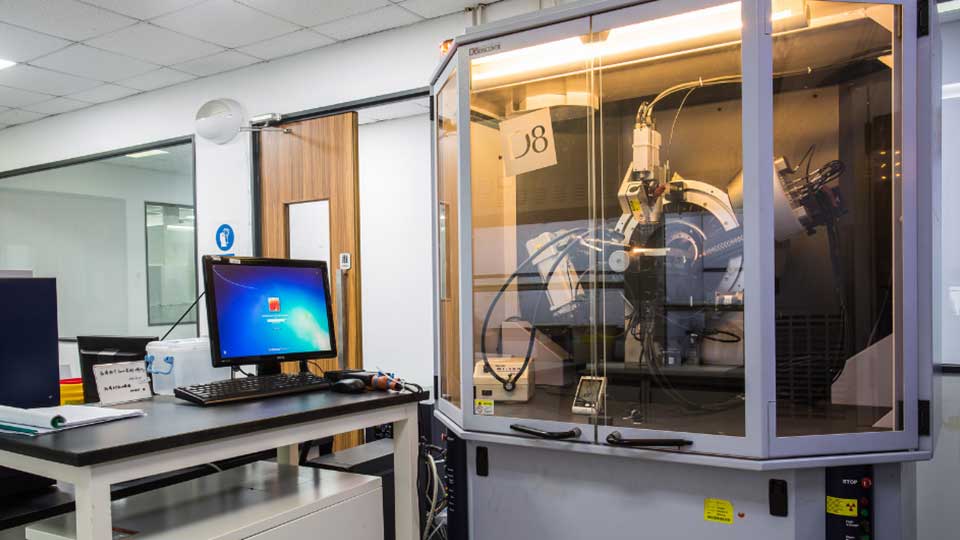
XRPD or Raman spectroscopy for phase identification
DSC for thermal transitions
TGA for dehydration and moisture analysis
Solid-state reviews consistently emphasize that no single analytical technique provides a complete picture. Reliable conclusions come from integrating complementary methods.
Crystal Pharmatech supports pharmaceutical development teams through integrated solid-state and hygrothermal characterization studies.
Capabilities include:
Dynamic vapor sorption (DVS) moisture sorption studies
Vapor-induced phase transition analysis
XRPD, DSC, and TGA characterization
Humidity-dependent solid-form stability mapping
These studies help define humidity-sensitive transformation ranges and solid-form stability windows early in development, allowing teams to move from "stable at one condition" to a robust CMC strategy for solid-form control.
1. Touil A, Peczalski R, Timoumi S, Zagrouba F. Influence of air temperature and humidity on dehydration equilibria and kinetics of theophylline. J Pharm. 2013;2013:892632. doi:10.1155/2013/892632.
2. Miyano T, Sugita K, Ueda H. The continuous and reversible transformation of the polymorphs of an MGAT2 inhibitor (S-309309) from the anhydrate to the hydrate in response to relative humidity. Pharmaceutics. 2024;16(7):949. doi:10.3390/pharmaceutics16070949.
Found this blog helpful? Whether you have a specific technical question or need expert support for your current pipeline, our team is here to help. Complete the form, and we'll reach out to discuss how our expertise can drive your success.
Our expertise spans three specialized platforms:
Small Molecule
Crystal Bio Solutions
Crystal NAX
By providing your e-mail address, you agree to receive an e-mail response from Crystal Pharmatech to your inquiry. The information you submit will be governed by our Privacy Policy.

Subscribe to be the first to get the updates!